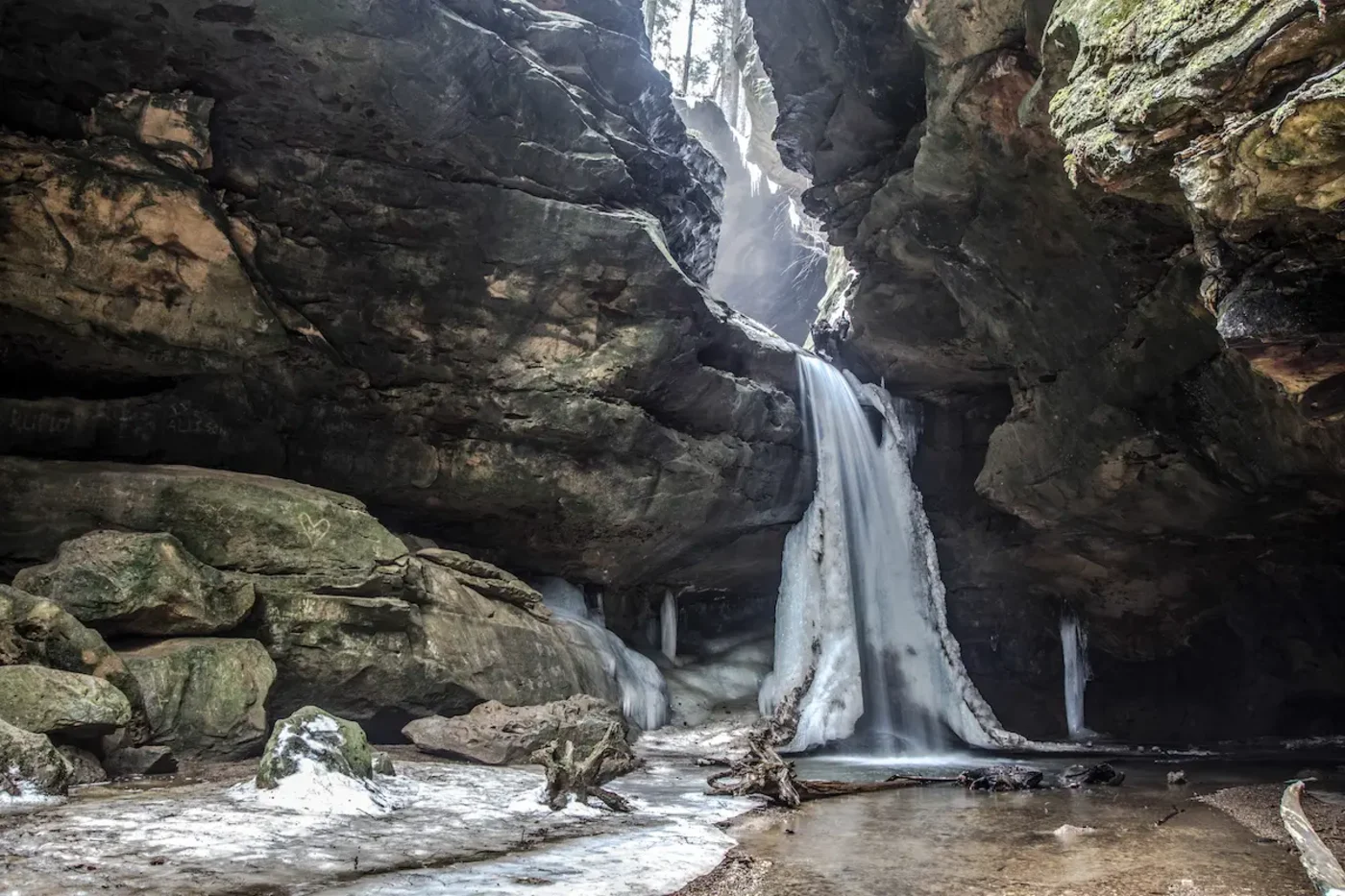
January is typically one of Hocking Hills' quieter, colder, more weather-dependent months. Trails often empty out, and a good cold snap can turn the region's waterfalls into ice formations you won't usually see any other time of year. But this isn't a low-effort visit: stairs, boardwalks, and gorge floors can ice over, days are short, and the payoff depends on conditions cooperating. If you're comfortable planning around the cold and mixing short hikes with indoor time, January rewards visitors who show up prepared.
January in Hocking Hills — At a Glance
| Good time to visit? | Yes, for the right visitor — cold, quiet, and occasionally spectacular ice formations, but not a comfortable-weather trip |
| Typical weather | Cold. Daytime highs commonly in the upper 30s°F, overnight lows often in the low-to-mid 20s°F, with periodic snow |
| Seasonal conditions | Snow and ice on trails, frozen or partly-frozen waterfalls during cold stretches, short daylight hours |
| Crowds | Typically the lightest of the year — empty trailheads are common, even on weekends |
| Hiking | Doable but slower and more deliberate — ice on stairs and gorge floors is a real hazard, not a minor inconvenience |
| What to pack | Insulated waterproof boots, traction devices, warm layers, hat and gloves |
| January is particularly good for | Frozen waterfall viewing, solitude, and trips that mix short outdoor time with a lot of time indoors |
What Hocking Hills Is Like in January
January is the off-season, and it feels like it the moment you pull into a trailhead lot that would be full in October and instead has two or three other cars in it. That quiet is the main reason to come this month. Ohio winter weather is genuinely variable week to week — a stretch of clear, bitter cold can be followed by a thaw with rain, so conditions at Old Man's Cave or Ash Cave can look completely different from one visit to the next.
This is not the month for a full day of trail-hopping. Daylight is short, footing is unpredictable, and the region's gorge trails — with their stone stairs and narrow boardwalks — are exactly the kind of terrain that turns hazardous when wet ground freezes. The visitors who do best in January plan a shorter, more careful hike or two, then fill the rest of the day with something indoors, whether that's the cabin fireplace, a nearby restaurant, or one of the area's indoor attractions.
Weather & What to Pack in January
Average Temperatures
- Typical daytime highs: roughly upper 30s°F
- Typical overnight lows: roughly low-to-mid 20s°F
- Snowfall is common but usually light-to-moderate rather than heavy; freezing rain and thaw-refreeze cycles are also common and are often the bigger hazard on trails
- Cold snaps and brief warm-ups can both happen within the same week — check the forecast for your specific travel dates rather than relying on a monthly average
What to Pack
- Insulated, waterproof hiking boots with real tread — not sneakers, not fashion boots
- Traction devices that strap onto your boots (such as microspikes) — one of the most useful pieces of gear for icy stairs and gorge floors
- Warm layers you can add or shed: base layer, insulating mid-layer, and a windproof/waterproof outer shell
- Hat, gloves, and wool or synthetic socks (avoid cotton, which stays wet and cold)
- A trekking pole or hiking stick if you have one — extra stability matters more this month than any other
- A plan for indoor time, since short daylight and cold limit how long you'll want to be outside at a stretch
Seasonal Conditions in January
Ice is typically the defining condition this month, and it's worth taking seriously rather than treating as scenery. The same stone steps and narrow boardwalks that make Hocking Hills' gorges dramatic in summer become genuinely dangerous when they ice over, and ice isn't always visible until you're on it. Trail surfaces can vary block to block — dry rock in one spot, black ice in the next — so go slower than you think you need to, keep a hand free, and be willing to turn around if a section looks bad. This isn't a month to hike in the dark; plan to be off the trails well before sunset, since daylight runs short and footing gets harder to judge as light fades.
The upside of the cold is the ice itself. During a sustained cold snap, dripping water at the region's waterfalls and rock overhangs freezes into columns, curtains, and formations that don't happen in warmer months. It's not guaranteed on any given day — a mild week can leave everything just wet and gray — but a solid stretch of freezing temperatures is exactly the setup to watch for.
Where to Explore in January
Old Man's Cave
Old Man's Cave is typically one of the most reliable spots in the region to see winter ice formations, since its gorge stays shaded and holds the cold well. The same features that draw crowds in fall — the stairs, the narrow gorge walkways, the waterfalls — are the parts to be most careful with in January; icy stone steps here are a known hazard, not a rare fluke. See the full Old Man's Cave trail guide for trail sections, parking, and accessibility details before you go.
Ash Cave
Ash Cave is the gentler winter pick: the main approach is a paved, mostly flat trail, which makes it a better option on days when you want the payoff (a massive rock overhang, and often ice formations dripping from its rim) without the stair-heavy terrain of other gorges. It's still worth checking for ice on the paved surface itself after a freeze-thaw cycle. See the Ash Cave trail guide for full details.
If icy stairs and uneven terrain are a concern for anyone in your group, our accessibility guide covers which trails and viewpoints require the least difficult footing. And if the forecast turns against you, our rainy-day guide has indoor options that work just as well for a cold or wet January afternoon.
January 2027 Events
62nd Annual Hocking Hills Winter Hike
A 6-mile guided winter hike passing Old Man's Cave, Cedar Falls, and Ash Cave, with interpretive stops and a hearty bean soup meal after. Free, but arrive early — recent years have drawn several thousand hikers.
Logan Frozen Festival
An annual winter street festival in downtown Logan with ice sculptures, food vendors, and family activities, held right after the Winter Hike each year. The exact 2027 date hadn't been published at the time of writing — the 2026 edition ran January 17, so expect it to land on or near January 16, 2027.
Plan your arrival
Our family tip: download your map before you go. Cell reception can be unreliable in Hocking Hills. We learned this the hard way: download an offline Google map while you still have Wi-Fi or a cell signal. Download an area that covers your whole drive, including the way back to where you are staying, and wait for the download to finish. Simply saving a place or opening directions is not the same as downloading an offline map. How to download a Google map for offline use. Offline maps support driving directions within the downloaded area; live traffic and walking directions are unavailable offline. Before leaving, save the official Hocking Hills park and trail map for offline use. For trails outside this map, use the relevant preserve or park map.
Before setting out, check the National Weather Service forecast for South Bloomingville and ODNR park information and notices. Weather and trail conditions can change; check posted notices at your destination too.
Choose a stop covered in this guide to open Google Maps. Select your current location or enter a starting address to see driving directions and an estimated travel time.
- Ash Cave — directions and estimated drive time
- Old Man’s Cave — directions and estimated drive time
- Cedar Falls — directions and estimated drive time
Drive times vary with traffic and road conditions. Follow signs for designated visitor parking on arrival; a map route does not confirm that a trail is open or accessible.
January FAQ
Is January a good time to visit Hocking Hills?
Yes, if you're prepared for winter conditions and don't mind cold. It's typically one of the quieter months of the year, with light crowds and a real chance to see frozen waterfalls — but trails can be icy, so it favors visitors who plan around the conditions.
What is the weather like in Hocking Hills in January?
Cold. Daytime highs typically run in the low-to-mid 30s°F, with overnight lows often in the teens to low 20s°F, and periodic snow.
Are the Hocking Hills trails safe to hike in January?
They can be, with the right gear and mindset. Ice on stairs, boardwalks, and gorge floors is the main hazard, so traction devices for your boots are worth having, and it's best to go slower and turn back if a section looks icy.
Can you see frozen waterfalls in Hocking Hills in January?
Often, yes. During a sustained cold snap, ice formations can build up at Old Man's Cave, Ash Cave, and Cedar Falls — but it's weather-dependent and not guaranteed on any given day.
Is Hocking Hills crowded in January?
Generally not — January is typically one of the quieter months of the year here, with trailhead parking lots that are often nearly empty even on weekends.
What should I pack for Hocking Hills in January?
Insulated waterproof boots, traction devices for icy stairs, warm layers, and a hat and gloves. Plan some indoor time too, since daylight is short this month.
Continue Planning Your Hocking Hills Trip
For the full trip-planning picture — every major trail, itineraries, and where to stay — see the Complete Guide to Visiting Hocking Hills. Traveling with kids or grandparents who'll need extra care on icy terrain? Our Hocking Hills with kids guide and Hocking Hills with grandparents guide both cover how to plan around exactly this kind of seasonal condition.
Planning a January Trip?
Pool House Lodge is a 7-bedroom Hocking Hills cabin for groups of up to 20, with a private indoor pool and 22 wooded acres.
Check AvailabilityOriginally published .