Your Starting Point for Planning a Hocking Hills Trip
Hocking Hills is not one compact town. The trails, restaurants, and lodging are spread across winding rural roads in southeastern Ohio, and there is no central entrance gate. This guide helps you make the decisions that matter before you arrive.
Use this page as the hub. Each section gives you a direct answer first, then links to a deeper guide when you want more detail.
Hocking Hills at a Glance
The short version, for anyone deciding whether this trip is right for them.
- Where it is
- Southeastern Ohio, about an hour southeast of Columbus. Logan is the main town.
- Best trip length
- Two to four nights. Two is a taste, three is a trip, four is relaxed.
- Known for
- Sandstone recess caves, waterfalls, hemlock gorges, and hiking trails.
- Best seasons
- Spring for waterfalls, fall for color. Summer is busiest, winter is quietest.
- Do you need a car?
- Yes. There is no public transit, no rideshare coverage worth relying on, and no walkable base.
- Good for families?
- Yes, with trail selection. Some trails are stroller-friendly, most are not.
- Park entry fee
- None. Ohio state parks are free to enter and free to park.
- Accessibility, honestly
- A few paved sections are genuinely accessible. Most trails are not, and stairs are common.
Where Is Hocking Hills?
Hocking Hills is a region, not a single park. It covers parts of Hocking, Vinton, and Fairfield counties in southeastern Ohio, centered on Hocking Hills State Park and Hocking State Forest. Most of the famous trail areas sit south and west of Logan, off State Route 664 and State Route 56.
Because there is no single entrance, each trail area has its own parking lot and its own drive. Getting between two trailheads usually takes 10 to 25 minutes on two-lane roads. That driving time is the single thing most first-time visitors underestimate.
Areas Worth Knowing
Logan
The practical hub. Groceries, gas, pharmacies, and the widest choice of restaurants. Most visitors pass through it.
South Bloomingville & SR 664
The corridor closest to Old Man's Cave, Cedar Falls, and Conkle's Hollow. Heavy weekend traffic in fall.
Nelsonville & Athens
Southeast of the park. More restaurants, the scenic railway, and a college-town feel in Athens.
Southern region (Vinton County)
McArthur, Zaleski State Forest, and Lake Hope. Quieter, more private acreage, a longer drive to the busiest trails.
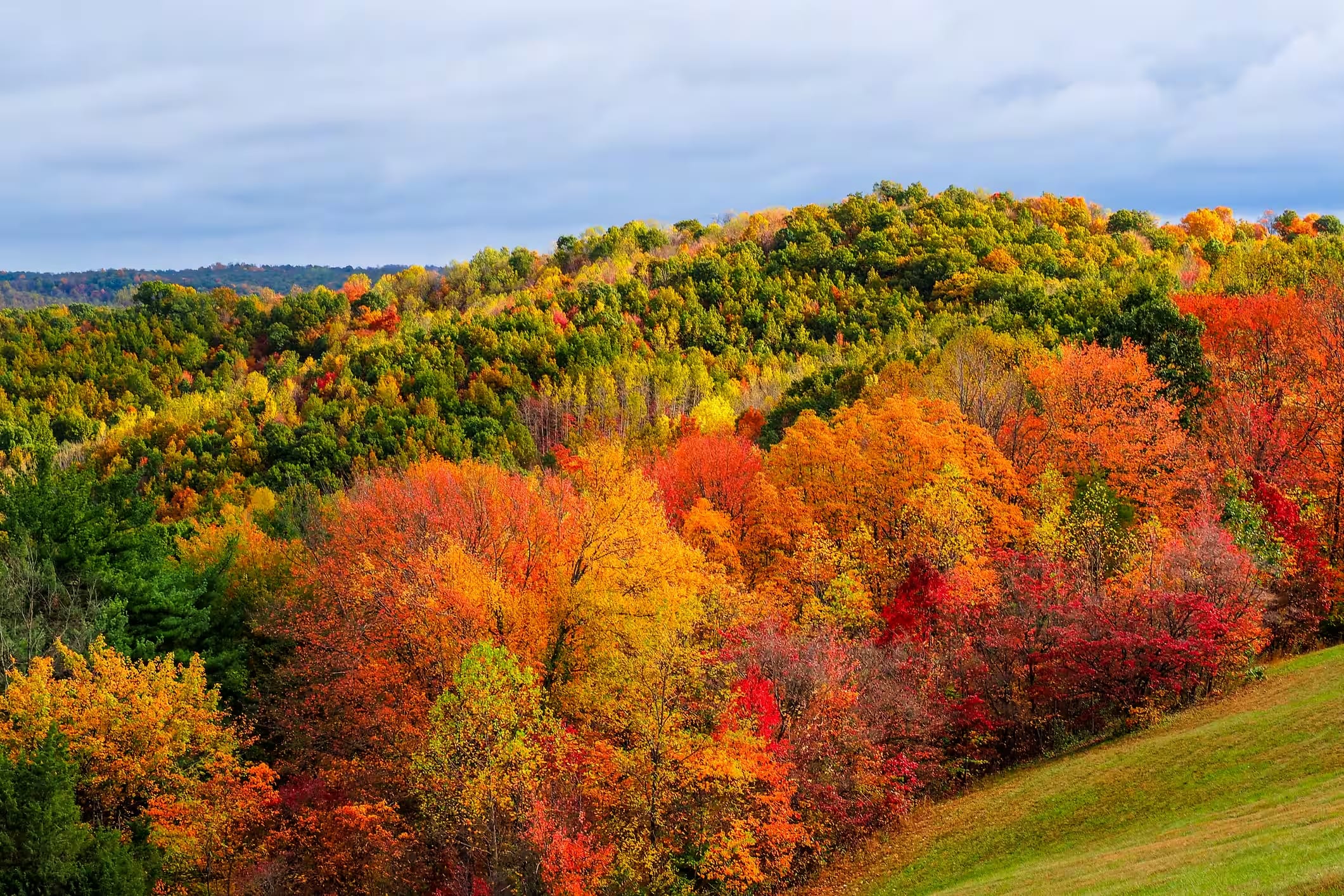
The Hocking Hills region spreads across several counties, connected by two-lane rural roads.
Drive Times From Nearby Cities
| Starting City | Approx. Drive | Planning Note |
|---|---|---|
| Columbus, OH | 1 to 1.5 hours | Easy weekend distance. Last full grocery stop is Logan. |
| Cincinnati, OH | 2 to 2.5 hours | Chillicothe is a good gas, food, and grocery break. |
| Cleveland, OH | About 3 hours | A three or four night stay beats a fast weekend from this distance. |
| Pittsburgh, PA | About 3 hours | Route 33 is well paved. Stock up before the last 30 miles. |
| Indianapolis, IN | About 3 to 3.5 hours | I-70 to Columbus, then southeast. Groceries before the rural stretch. |
| Detroit, MI | About 4.5 hours | Long enough that arrival day should not be a hiking day. |
When Is the Best Time to Visit Hocking Hills?
Short answer: late April through May for waterfalls and comfortable hiking, or mid to late October for fall color. Both are also the hardest weekends to book.
| Season | Best For | Watch Out For |
|---|---|---|
| Spring (Mar–May) | Strongest waterfall flow, wildflowers, cool hiking temperatures, thinner crowds | Mud, fast weather swings, cold mornings, occasional high water |
| Summer (Jun–Aug) | Long daylight, deep green gorges, swimming, family schedules | Heat and humidity, crowded weekends, holiday traffic, weaker falls in dry spells |
| Fall (Sep–Nov) | Peak color, photography, scenic drives, crisp hiking weather | Peak crowds and prices, full parking lots by mid-morning, lodging booked months out |
| Winter (Dec–Feb) | Quiet trails, ice formations, frozen falls, lower rates, real solitude | Ice on stairs and boardwalks, short daylight, some trail closures |
Season by Season
Spring. Snowmelt and spring rain put the most water over the falls. Cedar Falls and the Old Man's Cave falls are at their best. Trails are muddy and rock is slick, so tread carefully and expect wet shoes.
Summer. The gorges stay noticeably cooler than the parking lots, which makes hot days more tolerable than the forecast suggests. Waterfalls can slow to a trickle in a dry August. This is the season where a pool, a lake, or a shaded gorge matters more than mileage.
Fall. Color typically builds through October, with the widely watched window falling in the second half of the month. It varies year to year with rainfall and temperature, so check a current foliage report rather than booking on a fixed date. Weekend parking at Old Man's Cave can fill before 10 AM.
Winter. The region's quietest and most underrated season. Ice formations on the cliff faces are genuinely dramatic. Stairs and boardwalks ice over, so traction devices are worth carrying, and daylight is short enough that a 2 PM start is a bad idea.
How Many Days Do You Need in Hocking Hills?
Short answer: two nights minimum, three nights for most people, four or more if you are traveling with a group that includes kids or older adults.
1 Day
Enough for one trail area and one meal. Realistically that means Old Man's Cave or Ash Cave, not both plus anything else. A day trip works from Columbus and nowhere else.
2 Days
Two trail areas at a comfortable pace, or three if you start early and pack lunches. Good for couples and first-time visitors who mostly want to see the famous spots.
3 Days
The sweet spot. One arrival day, one full hiking day, one flexible day you can flip to indoor plans if it rains. Works for families and mixed-ability groups.
4+ Days
Reunions, multigenerational trips, and anyone who wants unstructured time. With four or more nights you can split the group by energy level on any given day without anyone feeling shorted.
The reason longer stays work better for groups is unglamorous: meals, coordinating departures, and different wake-up times eat more of the day than people expect. A group of twelve does not move like a group of two.
Best Things to Do in Hocking Hills
Hiking is the headline, but a trip built only on hiking wears people out by day two. Most good itineraries mix two or three of these categories.
Caves & Waterfalls
The signature experience. Recess caves carved into sandstone, with waterfalls dropping over the rims. Old Man's Cave, Ash Cave, and Cedar Falls are the classic three.
Hiking
Everything from a quarter-mile paved path to a strenuous clifftop rim loop. Difficulty varies enormously between trails in the same park, so read before you drive.
Scenic Areas & Drives
The back roads through farm country and state forest are worth driving for their own sake. Zaleski and Hocking State Forest roads are quiet and beautiful.
Water & Lakes
Lake Hope State Park has swimming, kayak and paddleboat rentals, and easy wooded trails. A good half-day when the main park is packed.
Adventure Activities
Zipline canopy tours, guided rappelling, and horseback riding operate seasonally in the region. Book ahead, especially on fall weekends.
Indoor & Rainy-Day
The scenic railway from Nelsonville, glassblowing studios, small-town shops in Logan, and wineries. See the rainy-day section below.
Stargazing
John Glenn Astronomy Park sits near Old Man's Cave and hosts free public programs. Dark skies here are genuinely good by Midwest standards.
Doing Nothing
The most consistently underrated option. Groups that build in porch time, long dinners, and an unscheduled afternoon report better trips than groups that fill every hour.
Major Hocking Hills Trails & Attractions
Allow 1.5 to 2.5 hours per trail area including parking, walking, and stopping to look at things. Two areas in a day is comfortable. Three is a push. Four is a bad day out.
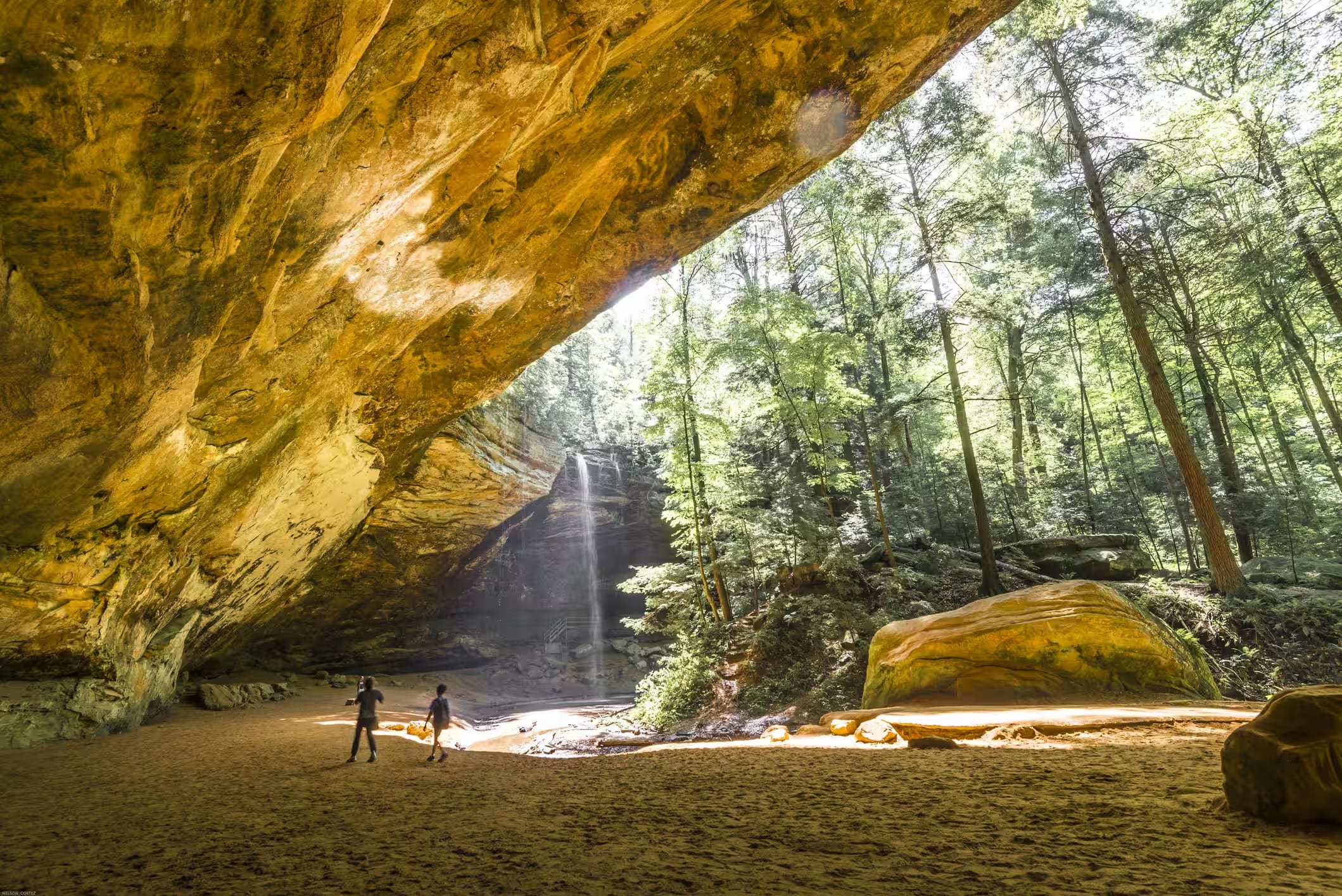
Ash Cave is the largest recess cave in Ohio and the easiest of the major trail areas to reach on foot.
Old Man's Cave
- Best for
- First-time visitors who want the signature Hocking Hills experience
- Difficulty
- Moderate. Stairs, bridges, tunnels, uneven stone, some narrow passages
- Typical visit
- 1.5 to 2.5 hours for the gorge and back
- Why visit
- The most dramatic concentration of scenery in the region: upper and lower falls, the Devil's Bathtub, deep hemlock gorge, and the recess cave itself. If you only do one trail, this is it.
- Important consideration
- It is also the busiest — parking fills earliest here on weekends and through October.
Full Old Man's Cave trail guide: stairs, parking, and what kids & grandparents can handle →
Plan your arrival
Our family tip: download your map before you go. Cell reception can be unreliable in Hocking Hills. We learned this the hard way: download an offline Google map while you still have Wi-Fi or a cell signal. Download an area that covers your whole drive, including the way back to where you are staying, and wait for the download to finish. Simply saving a place or opening directions is not the same as downloading an offline map. How to download a Google map for offline use. Offline maps support driving directions within the downloaded area; live traffic and walking directions are unavailable offline. Before leaving, save the official Hocking Hills park and trail map for offline use. For trails outside this map, use the relevant preserve or park map.
Before setting out, check the National Weather Service forecast for South Bloomingville and ODNR park information and notices. Weather and trail conditions can change; check posted notices at your destination too.
Choose a stop covered in this guide to open Google Maps. Select your current location or enter a starting address to see driving directions and an estimated travel time.
- Ash Cave — directions and estimated drive time
- Conkle’s Hollow — directions and estimated drive time
- Old Man’s Cave — directions and estimated drive time
Drive times vary with traffic and road conditions. Follow signs for designated visitor parking on arrival; a map route does not confirm that a trail is open or accessible.
Originally published .
Ash Cave
- Best for
- Families with strollers, visitors with limited mobility, short-on-time stops
- Difficulty
- Easy on the paved gorge trail. The separate rim trail is moderate with stairs
- Typical visit
- 45 minutes to 1 hour
- Why visit
- The largest recess cave in Ohio, and the scale genuinely surprises people. A wide, flat, paved path leads through a hemlock corridor straight to the cave mouth and its horsetail waterfall.
- Important consideration
- This is the most accessible major trail in the park, which also means it can feel crowded despite being an easy walk. Go early or late in the day.
Full Ash Cave trail guide: waterfall timing, parking & wheelchair access →
Cedar Falls
- Best for
- Waterfall photography and hikers who want the falls without a long approach
- Difficulty
- Moderate. A stepped descent into the gorge and back out
- Typical visit
- 1 to 1.5 hours from its own parking area
- Why visit
- The highest-volume waterfall in the park. After heavy rain or spring snowmelt it is the most impressive water in Hocking Hills.
- Important consideration
- You can also reach it by hiking the Grandma Gatewood Trail from Old Man's Cave, which is a much longer commitment. Check which version your group signed up for.
Conkle's Hollow
- Best for
- Two very different groups: easy-walk families on the gorge trail, and experienced hikers on the rim
- Difficulty
- Gorge trail is easy and partly paved. Rim trail is difficult with exposed cliff edges
- Typical visit
- 45 minutes for the gorge trail, 2 to 2.5 hours for the rim loop
- Why visit
- A narrow gorge with cliff walls rising over 200 feet, and one of the most striking places in the region to look straight up.
- Important consideration
- This is a state nature preserve, not a state park — pets are not permitted. The rim trail has unguarded drop-offs and is not for young children or anyone uneasy with heights; the gorge trail is a different, easier trip.
Full Conkle's Hollow trail guide: Gorge Trail vs. Rim Trail →
Rock House
- Best for
- Visitors who want something distinct from another gorge and waterfall
- Difficulty
- Moderate. A steep set of stairs down to the formation and back up
- Typical visit
- 45 minutes to 1 hour
- Why visit
- The only true cave in the park — a corridor tunneled into the middle of a cliff face, with window-like openings looking out over the gorge. It photographs unlike anywhere else here.
- Important consideration
- The climb back out is short but steep. The cave floor is uneven rock, and it stays damp and slick.
Cantwell Cliffs
- Best for
- Repeat visitors and anyone trying to escape crowds on a peak weekend
- Difficulty
- Moderate to difficult. Steep stairs, tight passages, real elevation change
- Typical visit
- 1.5 to 2 hours
- Why visit
- Dramatic cliff faces and a genuinely different feel from the southern trail areas. The narrow passage known as Fat Woman's Squeeze is the best-known feature.
- Important consideration
- It sits at the far northern end of the park, roughly 20 to 30 minutes from Old Man's Cave. Do not tack it onto a full day — give it its own slot.
Rockbridge State Nature Preserve
- Best for
- Hikers who want a single dramatic feature and don't mind a real hike with hills to reach it
- Difficulty
- Moderate. Natural, uneven surface with hills across roughly 2.75 miles of trail
- Typical visit
- 1.5 to 2.5 hours for both loops
- Why visit
- Widely considered Ohio's largest natural bridge — a Black Hand sandstone arch more than 100 feet long, spanning about 50 feet across a ravine. It's a separate property from Rock House, despite the similar name.
- Important consideration
- This is a separate state nature preserve near the village of Rockbridge, not part of Hocking Hills State Park itself, and pets are not permitted anywhere on the grounds.
Hocking Hills With Kids & Families
Short answer: yes, it works well — if you pick trails by the youngest or slowest member of the group and cut your planned mileage roughly in half.
Ash Cave's paved trail suits toddlers and strollers; Old Man's Cave is the sweet spot for school-age kids (tunnels, bridges, stairs, water); teens can handle rim trails and Cantwell Cliffs. One trail area plus one non-hiking activity per day — a lake, a train ride, a pool — holds up better than stacking hikes.
Hocking Hills With Grandparents & Limited Mobility
Limited mobility is not the same thing as wheelchair accessibility, and treating them as one problem fails both groups. The real obstacles are stairs, uneven ground, and deceptive distances — not paved-versus-unpaved.
Ash Cave's paved trail is the single best option for someone who wants to see something remarkable without a hard walk. Conkle's Hollow's gorge trail is easy and mostly level (the rim trail above it is a different, unsuitable trail — don't confuse the two). The upper Old Man's Cave area near the visitor center can be seen without the full gorge descent. Lake Hope offers real scenery from a car or a short flat walk.
Accessible Hocking Hills
Short answer: Hocking Hills is not broadly wheelchair accessible. Two specific trails are — the Ash Cave gorge trail (paved, close to level, ends somewhere genuinely worth seeing) and the paved opening section of Conkle's Hollow — and they're worth the trip. Old Man's Cave, Cedar Falls, Rock House, Cantwell Cliffs, and the Conkle's Hollow rim trail are not: all involve stairs, steep grades, or natural rock surfaces, and winter ice makes even the accessible paths unreliable.
Trail conditions and closures change. Ohio Department of Natural Resources posts current alerts, and calling the park office before a trip is worth the five minutes if accessibility is critical to your plans.
What to Do in Hocking Hills When It Rains
Rain is common here in spring and not rare any other season. Weather moves fast, and a forecast showing rain all day often means two heavy hours and a grey afternoon. A backup plan is standard, not pessimistic.
Waterfalls run harder and look better in the rain — Cedar Falls and Old Man's Cave especially — and Ash Cave's cave floor stays dry under its own overhang. Indoors, the Hocking Valley Scenic Railway, Logan's shops and washboard factory, local wineries, and a long lunch in Logan or Nelsonville all hold up well on a wet day.
Hocking Hills Itineraries
Three starting points. Adjust for weather, group size, and how early anyone is actually willing to leave.
One-Day Hocking Hills Itinerary
Realistic for a Columbus day trip. Do not try to add a second park.
- Morning. Arrive at Old Man's Cave before 9 AM. Hike the gorge, allow two hours.
- Midday. Lunch in Logan or a packed lunch at a picnic area.
- Afternoon. Ash Cave. Short, paved, and an easy finish for tired legs.
- Skip. Cantwell Cliffs and any rim trail. There is no time.
Two-Day Hocking Hills Itinerary
- Day 1. Arrive, groceries in Logan, settle in. Late afternoon: Ash Cave or Rock House — short, low commitment, gets you outside on arrival day.
- Day 2. Old Man's Cave early, then Cedar Falls. Lunch between them. Back by mid-afternoon.
- Optional. If the group has energy left, Conkle's Hollow gorge trail is a 45-minute add-on.
Three-Day Hocking Hills Itinerary (Sample Plan)
- Day 1 — Arrive. Groceries in Logan or Nelsonville before the rural roads. Unpack, walk the property, keep dinner simple. Arrival day is not a hiking day.
- Day 2 — Main trail day. Old Man's Cave at 9 AM or earlier. Lunch. Ash Cave or Cedar Falls in the afternoon. Back by 4 PM.
- Day 3 — Flexible. Check the weather at breakfast and pick: Conkle's Hollow or Cantwell Cliffs for a quieter hike, Lake Hope for water and easy walking, or a full indoor day with no schedule at all.
Longer stays work best when you add rest days rather than more trails. A four-night trip with three hiking days and one deliberately empty day beats four hiking days every time.
Where to Eat & Buy Groceries
Dining close to the trailheads is limited. Logan has the widest choice within a reasonable drive. Nelsonville and Athens offer more variety if you are willing to go further. Nothing is open late.
Groceries
Logan has a full supermarket and a supercenter — the last real grocery stop before the rural roads. Buy here, not after.
Casual & family dining
Logan and Nelsonville cover barbecue, pizza, diners, and pub food. Portions are generous and prices are reasonable.
Coffee & breakfast
A handful of independent cafes in Logan. Many open early for hikers and close by mid-afternoon.
Takeout
Available in Logan, but delivery to cabins is generally not. Assume pickup, and assume a drive.
Planning Food for a Cabin Stay
- Shop before you arrive. Either at home or in Logan. Once you are on the rural roads there is very little.
- Cook two or three dinners. Groups that cook most nights consistently report better trips than groups that plan to eat out every night, mostly because of drive time.
- Assign meals. In a large group, one family per dinner works far better than a nightly committee decision.
- Bring a cooler. Trailhead picnics save an hour of driving in the middle of a hiking day.
- Call ahead for large groups. Most restaurants here are small. A table for twelve without notice is a long wait or a no.
Hungry Buffalo
Hungry Buffalo is a casual bison-burger-and-bar restaurant in Logan with a general store, axe-throwing, and a golf simulator on site — part restaurant, part local hangout. It is a good fit for a group that wants more than a quiet dinner. For current hours, prices, and menu, check Hungry Buffalo's website directly, since small-town hours change often.
Practical Hocking Hills Planning
Direct answers to the questions that actually change how a trip goes.
Do you need a car?
Yes. There is no public transit, rideshare coverage is unreliable, and no lodging area is walkable to trails. Every group needs at least one vehicle, and groups over eight usually want two.
How far apart are the attractions?
Ten to twenty-five minutes between most major trail areas, on two-lane roads. Cantwell Cliffs is the outlier at the northern end. Budget more time than the map suggests.
What is cell service like?
Unreliable to nonexistent in the gorges and on many rural roads. Download offline maps in Google Maps and AllTrails before you leave home, and save your lodging directions as a screenshot.
What should you pack?
Closed-toe shoes with grip, layers, rain jacket, refillable water, a small first-aid kit, a headlamp or flashlight, and bug spray in summer. Traction cleats in winter. No concessions at most trailheads.
What are trailhead bathrooms like?
Basic. Some are vault toilets, some are seasonal, some are closed. The visitor center near Old Man's Cave is the most reliable. Plan around it rather than hoping.
What about parking?
Free, but limited. Old Man's Cave fills first. On peak fall weekends lots reach capacity by mid-morning and overflow parking adds a walk. Do not park on road shoulders where it is prohibited.
When should you arrive at a trail?
Before 9 AM on any weekend, and before 9 AM on any October day. Late afternoon after 4 PM is the second-best window. Midday on a Saturday in October is the worst.
What happens on busy weekends?
Full lots, slow single-file sections on narrow trails, and waits at restaurants. It is still worth going — just start earlier, pick less-visited areas like Cantwell Cliffs or Rock House, and eat off-peak.
How fast does the weather change?
Fast. Gorges run cooler than the surrounding area, sometimes noticeably. Carry a layer even on a warm forecast, and check for trail closures after heavy rain, ice, or storms.
Can you bring a dog?
Leashed dogs are allowed on most Hocking Hills State Park trails, but not in state nature preserves — Conkle's Hollow included. Check the rules for each specific area before you go.
Is there an entry fee?
No. Ohio state parks are free to enter and free to park. Guided activities, canopy tours, and the scenic railway are separately ticketed.
Are drones allowed?
No. Drone use is prohibited in Ohio state parks without a permit. Assume you cannot fly one at any of the major trail areas.
Where to Stay in Hocking Hills
Lodging here runs from tent sites to large private lodges. The right choice depends less on budget than on group makeup and how much time you will actually spend at the property. In a region where it rains and trails close, the property is part of the trip, not just a bed.
| Type | Best For | Things to Know |
|---|---|---|
| Camping / tent | Budget travelers, experienced campers | Reserve early; popular sites fill months ahead. No backup plan when it rains. |
| Glamping / yurt / treehouse | Couples wanting comfort with an outdoor feel | Usually 2 guests. Limited or no kitchen. Check bathroom arrangements carefully. |
| Small cabin | Couples and families of 4 to 6 | Quality varies enormously. Read recent reviews, not just the photos. |
| Large group cabin / lodge | Reunions, extended families, groups of 10 or more | Compare bathrooms per person, kitchen capacity, and indoor common space — not just bed count. |
| Hotel / motel | One-night stops and simple budgets | Concentrated in Logan. Limited options, and you lose the point of being out here. |
| State park lodge | Travelers who want on-site dining and no cooking | Books far ahead in peak season. Less privacy than a private cabin. |
Matching Lodging to Your Group
- Couples. Almost anything works. Prioritize privacy and a hot tub over square footage.
- Small families. A real kitchen and a second bathroom matter more than an extra bedroom.
- Large families and reunions. Count bathrooms, seats at the table, and indoor gathering space. A house that sleeps sixteen with one dining table for eight does not work.
- Multigenerational groups. Look for a ground-floor bedroom and bathroom, step-free entry, and somewhere for grandparents to sit comfortably away from the noise.
- Accessibility needs. Ask specific questions: doorway widths, thresholds, shower type, grab bars, path from parking. "Accessible" in a listing is not a regulated term.
- Groups wanting indoor amenities. If rain would ruin the trip, book somewhere with a genuine indoor option — pool, game room, or large common area.
Which Part of Hocking Hills Should You Stay In?
There is no single lodging village here, so the area you book decides how much of your trip you spend in the car. Five broad bases cover almost everything, and each one trades something for something else.
- The SR 664 corridor and South Bloomingville. Closest to Old Man's Cave, Cedar Falls, and Conkle's Hollow, which is exactly why it books first and costs most in October. Choose it if beating the parking crowds with a five-minute morning drive is the priority. You give up quiet: this is the busiest stretch of road in the region on a fall weekend.
- Logan and the roads just outside it. The practical compromise. You are minutes from the supermarket, gas, a pharmacy, and most of the restaurants, and still inside about twenty-five minutes of the main trailheads. The best pick for groups who plan to cook, for anyone arriving after dark, and for trips where somebody may need a store run mid-stay.
- Nelsonville and toward Athens. Southeast of the park, with the scenic railway, more restaurants, and a college-town afternoon available. Add roughly half an hour each way to the caves. Good for trips that split time between hiking and eating out, less good for early trailhead starts.
- The southern region — McArthur, Lake Hope, and the Vinton County side. Quieter roads, more acreage per property, and closest to Lake Hope State Park, Zaleski State Forest, and the Moonville Rail Trail. The trade is a longer drive to the famous trails. That matters much less on a three- or four-night trip where the property itself is part of the plan, and much more on a fast two-night hiking weekend.
- The far north end, near Cantwell Cliffs and Laurelville. Rarely the right base on its own, because it puts twenty to thirty minutes between you and everything in the southern cluster. Worth it only if Cantwell Cliffs, Rock House, and the northern back roads are genuinely the point of the trip.
One rule holds across all five: pick the base that fits your slowest morning, not your most ambitious one. Groups consistently overestimate how early they will leave and underestimate how long two-lane roads take.
What Should You Ask Before Booking a Cabin?
Photos and bed counts are the least useful parts of a listing. These are the questions that actually predict whether a property will work for your group.
- How many bathrooms per person? Roughly one full bathroom per four people is the line below which mornings get tense. Count half-baths separately — they do not solve the shower problem.
- How many people can sit down and eat at once? Dining seats, not sleeping capacity, is what limits a group dinner. A house that sleeps sixteen with a table for eight will feel wrong every single night.
- Is there one indoor space that holds everybody? This is the entire rainy-day question. Three small sitting rooms is not the same thing as one room where the whole group can be together while it pours.
- Where are the bedrooms relative to each other? Mixed-age groups usually want a ground-floor bedroom with a bathroom near it, plus some distance between the 6 AM people and the 1 AM people.
- What is the last mile like? Gravel, steep, unlit driveways are normal out here. Ask specifically if you are coming in winter, driving a low-clearance car, or arriving after sunset.
- What is the real driving time to the trailheads? Ask for minutes, not miles. Map distances in this region are consistently misleading because almost none of it is straight or fast.
- What is the cell signal and Wi-Fi actually like? Coverage is patchy across the whole area. If anyone has to work, take a call, or stay reachable for a family reason, confirm it rather than assume it.
- What are the rules on pets, extra vehicles, and gatherings? These vary enormously between properties, and parking is a real constraint when a group of fourteen arrives in five cars.
- How recent are the reviews? Properties change hands and standards drift. Reviews from the last six months tell you more than a five-year average.