Conkle’s Hollow State Nature Preserve has two separate walks: a roughly one-mile gorge round trip and a roughly two-mile rim loop. The gorge is partly paved; the rim has climbs and exposed cliff edges. Pet dogs are not allowed. Choose the route that fits your group before leaving the trailhead.
Before you go
- Admission and parking: Free.
- Pets: Pet dogs are not allowed, even on a leash.
- Facilities: The official map marks parking and restrooms at the trailhead; confirm current availability before relying on them.
- Timing: See the route estimates below and leave enough daylight for your return.
Gorge or Rim Trail: which should you choose?
Both routes begin near the Big Pine Road visitor parking area. Use the official ODNR map and posted trail directions.
Gorge Trail — shorter walk, partly paved
About 1 mile round trip: the mapped 0.5-mile trail runs into the hollow, then you return the same way. The gorge floor is mostly level, with concrete followed by an unpaved final stretch.
Can a wheelchair or stroller reach the waterfall? The map marks wheelchair access only to the end of the sidewalk, before the waterfall. Plan a paved-section visit and turn back there; do not assume the full route is suitable for wheels. Check surface conditions before visiting.
Rim Trail — longer loop with exposed cliffs
About 2 miles total: ODNR’s regional map labels the loop 1.9 miles. It climbs above the hollow and returns to the trailhead area, with steep climbs and descents, numerous uneven steps, roots and exposed edges.
Choose this route only if everyone is comfortable with heights and demanding terrain. It is not a wheelchair or stroller route. Follow the signed direction and stay on the marked path.
How long should you allow for each trail?
The field-checked local trail guide suggests about one hour for the complete Gorge Trail and several hours for the Rim Trail. Treat these as planning estimates, allowing extra time for your pace, stops and conditions. A pavement-only gorge visit is shorter than the full route.
Which trail works better for children or limited mobility?
The gorge is the more practical starting point for a family or mixed-mobility group. The rim’s cliff exposure makes it a poor choice for young children or anyone who may approach an edge unexpectedly. For other outings, compare our kids guide and accessible trail guide.
If you want to walk both routes, plan them as separate walks from the trailhead, with a break between them. If your group splits up, agree on a meeting place and time before setting out.
Where do you park, and how do you get there?
The public trailhead is at 24858 Big Pine Road, Rockbridge, OH 43149. Use designated visitor spaces. If the lot is full, choose another stop or return later; roadside pull-offs are not automatically authorized parking. A weekday morning may offer more flexibility, but does not guarantee a space.
What are the opening hours?
Ohio DNR’s Conkle’s Hollow page lists access from 30 minutes before sunrise to 30 minutes after sunset. Follow entrance signs and current closure notices; leave time to return before dark.
Plan your arrival
Download your maps before you go. We learned the hard way that cell service can be unreliable. While connected, download an area covering the drive there and back, and wait for it to finish. Saving a place is not the same as downloading a map. How to download a Google map for offline use official trail map Save the trail map too: offline Google Maps provides driving directions, but not walking directions or live traffic.
Before setting out, check the National Weather Service forecast for South Bloomingville and ODNR park information and notices. Weather and trail conditions can change; check posted notices at your destination too.
Get directions and estimated drive time on Google Maps. Choose your current location or enter a starting address to see the route to Conkle’s Hollow. Follow signs for designated visitor parking on arrival.
What should you bring?
- Shoes with grip: Closed-toe walking shoes for the gorge; sturdy hiking footwear for the rim. Wet pavement, mud and ice can change the footing.
- Water and weather layers: Bring a filled bottle, rain protection as needed and a light layer for the shaded hollow.
- Family extras: Spare socks and a change of clothes for rain or mud.
- Navigation: Keep the trail map available offline, separate from your driving map.
See the gorge surface before your visit
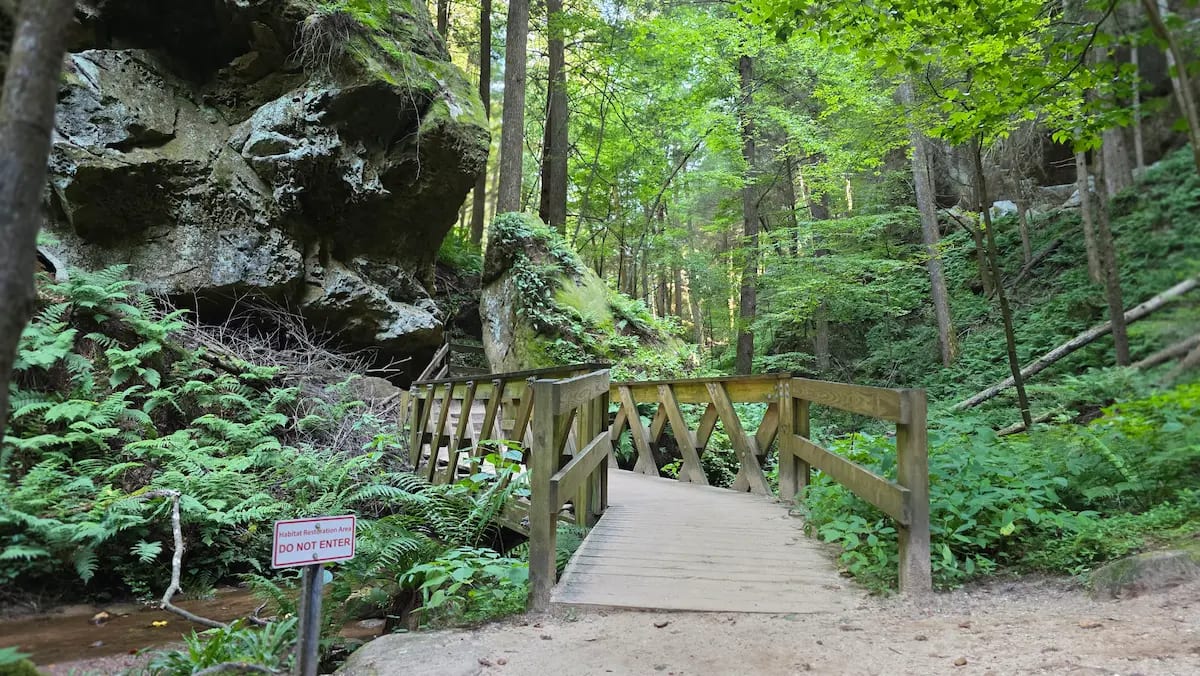
A look at the paved Gorge Trail at Conkle’s Hollow
Will you see a waterfall, and when should you visit?
The map marks a waterfall at the back of the gorge. Flow depends on recent rainfall and may be slight during dry weather. The walls and woodland are reasons to visit even without a strong waterfall.
Can you swim or wade? No. ODNR’s regional trail rules prohibit swimming and wading. Enjoy the creek and waterfall from the marked trail.
Spring greenery and fall leaves offer different scenery; fall-color timing varies. Summer shade can feel cooler than open areas. In winter, snow and ice may make even the pavement difficult to use. Check current conditions rather than treating a paved trail as a guarantee of safe access.

How can you plan a half-day around Conkle’s Hollow?
Start with one route, return to the trailhead for a break, then decide whether everyone has the time and energy for another stop. For a gentler plan, choose the gorge’s paved section and leave the rim for a separate outing. Compare Ash Cave’s paved approach and stepped return before adding a second walk. Our existing four-day Hocking Hills itinerary offers a wider trip plan.
What else can you visit nearby?
Ash Cave offers another paved approach to compare for access needs. Old Man’s Cave has a different gorge experience with stairs and uneven terrain. Check each guide’s route and parking details before combining stops.
A few more planning questions
Do I need tickets or a reservation?
No. A regular trail visit does not require a ticket or reservation. Check Ohio DNR notices before leaving for any closures or access changes.
How far is Conkle’s Hollow from Pool House Lodge?
About 25 minutes (14 miles), based on the owner-verified driving estimate. Actual travel time depends on your route and conditions.
Plan a Stay Near Conkle’s Hollow
Pool House Lodge is in McArthur, Ohio. Review wheelchair access details and limits or group sleeping arrangements to see whether it fits your stay.
Check AvailabilityOriginally published .